A novel hypothesis: Could water trapped in bottles and containers affect the hydrological cycle and climate?
Climate change in the Anthropocene era, does 2+2 equal 4?
DOI:
https://doi.org/10.5281/zenodo.18001169Keywords:
Bottled water, Global wraming, Ocean warming, Anthropogenic pressures, Novel hypothesesAbstract
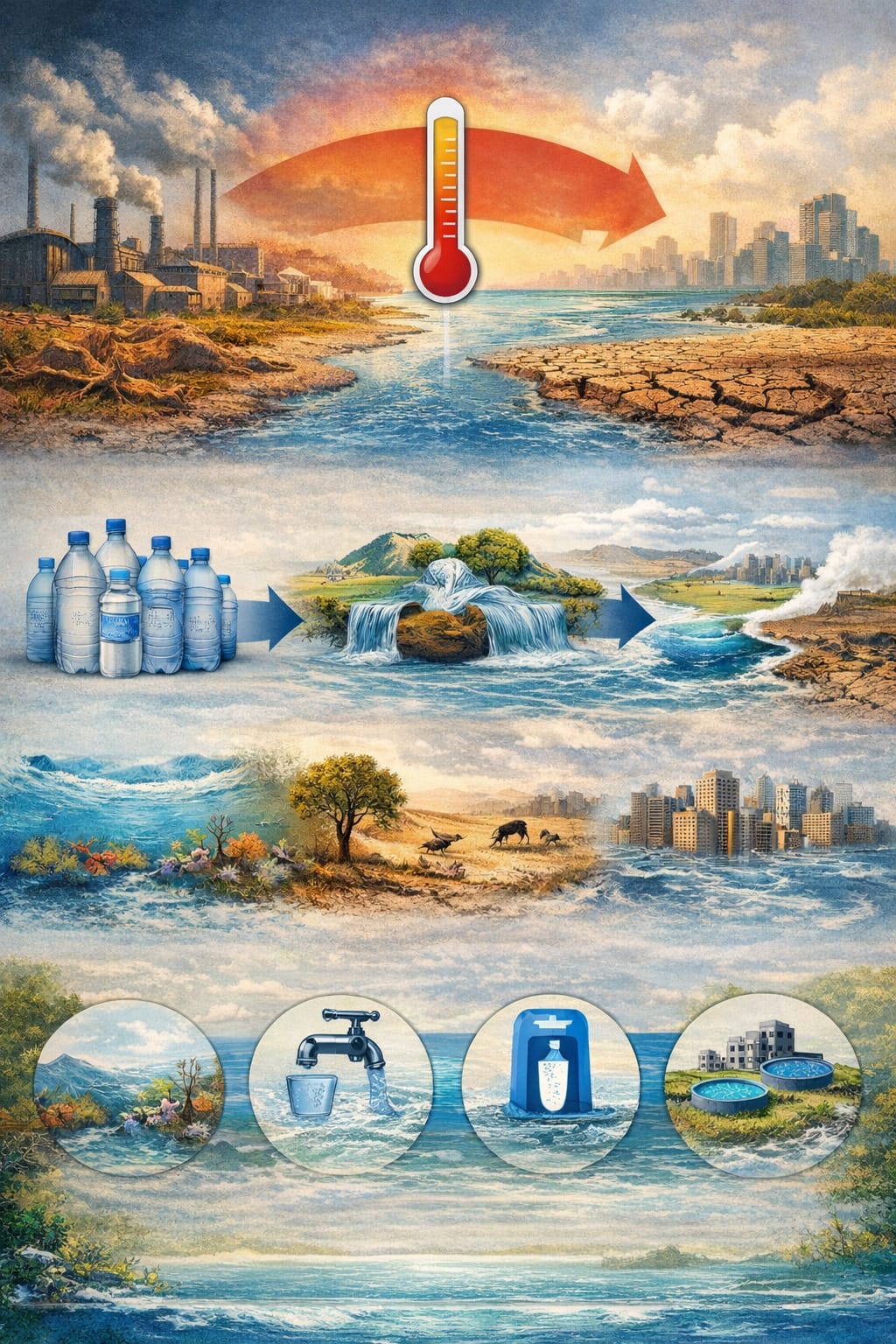
The Anthropocene marks a period where human activity dominates Earth’s climate system. Since the Industrial Revolution, fossil fuel use, deforestation, and intensive agriculture have sharply increased greenhouse gases, raising global temperatures by an average of 1.19°C between 2014 and 2024—approaching the 1.5°C threshold. Atmospheric CO₂ has climbed from ~280 to over 420 ppm, intensifying ocean acidification, sea-level rise, and ecological disruption. This study introduces a new hypothesis: that disruptions in the natural water cycle also amplify climate change. Water trapped in bottled or packaged forms weakens carbon sinks and alters hydrological circulation. Industrialization and massive plastic bottle use reinforce this effect. Thus, climate mitigation should not only reduce emissions but also restore natural water flows. Key strategies include reducing packaged water, promoting clean tap water, expanding refill stations, and improving water treatment. Furthermore, it is recommended that the
storage and circulation of bottled and packaged water be better regulated and managed to minimize disruption to the natural water cycle. Protecting water’s natural flow is crucial for maintaining global climate stability.
References
Abbott, B.W., Bishop, K., Zarnetske, J.P. et al., 2019. Human domination of the global water cycle absent from depictions and perceptions. Nature Geosciences, 12, 533–540. doi:10.1038/s41561-019-0374-y
Abeles, R. H., Frey, P. A. & Jencks, W. P., 1992. Biochemistry. Jones and Bartlett, Boston.
Aresta, M. and Dibenedetto, A., 2021. The carbon dioxide revolution. Carbon Dioxide Revolution, 31–43.
Boers, N., Marwan, N., Barbosa, H. M., Kurths, J., 2017. A deforestation-induced tipping point for the South American monsoon system. Science Reports, 7 (1), 41489. doi:10.1038/srep41489
Bouhlel, Z., Köpke, J., Mina, M., Smakhtin, V. 2023. Global bottled water industry: A review of impacts and trends. United Nations University Institute for Water, Environment and Health, Hamilton, ON, Canada.
Bourdin, S., Kluft, L., & Stevens, B., 2021. Dependence of climate sensitivity on the given distribution of relative humidity. Geophysics Research Letters, 48, e2021GL092462. doi:10.1029/2021GL092462
Can, E. and Austin, B., 2025. How much water is in prison in our world? Sustainable Aquatic Research, 4 (1), 1–3. doi:10.5281/zenodo.15181920
Chahine, M.T., 1992a. The hydrological cycle and its influence on climate. Nature (London), 359, 373–380. doi:10.1038/359373a0
Chahine, M.T., 1992b. GEWEX: The global energy and water cycle experiment. Eos, Transactions of the American Geophysics Union, 73 (2), 9–14.
Chalmin, P., 2019. The history of plastics: from the Capitol to the Tarpeian Rock. Field Actions Sciientific Reports, Journal of Field Actions, (Special Issue 19), 6–11.
Coca-Cola Company, 2021. 2021 Business and ESG Report. The Coca-Cola Company, Atlanta, 86 p.
Dabanlı, İ., 2021. İklim değişikliği ve artan orman yangınları ilişkisi. In: Orman yangınları sebepleri, etkileri, izlenmesi, alınması gereken önlemler ve rehabilitasyon faaliyetleri, 25–42.
Denson, E., Wasko, C., Peel, M.C. 2021. Decreases in relative humidity across Australia. Environmental Research Letters, 16 (7), 074023.
Education Overview – CERES, 2022, April 8. Clouds and the Earth's Radiant Energy System. NASA CERES Project. Retrieved October 6, 2022, from https://ceres.larc.nasa.gov/news/education-overview/
Ellis, E. C., Klein Goldewijk, K., Siebert, S., Lightman, D., & Ramankutty, N. (2010). Anthropogenic transformation of the biomes, 1700 to 2000. Global ecology and biogeography, 19(5), 589-606.
Ellison, D., 2017. Trees, forests and water: Cool insights for a hot world. Global Environmental Change, 43, 51–61.
ESSD, 2024. Global surface temperature dataset. Earth System Science Data. https://essd.copernicus.org/articles/16/2625/2024/
FAO, 2022. Global forest resources assessment 2022. Food and Agriculture Organization of the United Nations. https://www.fao.org/forest-resources-assessment
Forster, P. M., Smith, C., Walsh, T., et al., 2024. Indicators of global climate change 2023: annual update of key indicators of the state of the climate system and human influence. Earth System Science Data, 16, 2625–2658. doi:10.5194/essd-16-2625-2024
Geyer, R., 2020. A brief history of plastics. In: Mare plasticum – The plastic sea: Combatting plastic pollution through science and art, 31–47. Springer International Publishing, Cham.
Ghoshal, G., 2019. Recent development in beverage packaging material and its adaptation strategy. Trends in Beverage Packaging, 21–50.
Hall, N.D., 2009. Protecting freshwater resources in the era of global water markets: lessons learned from bottled water. University of Denver Water Law Review, 13, 1–21.
Heathwaite, A.L., 2010. Multiple stressors on water availability at global to catchment scales: understanding human impact on nutrient cycles to protect water quality and water availability in the long term. Freshwater Biology, 55, 241–257.
Hoekstra, A.Y. and Mekonnen, M.M., 2012. The water footprint of humanity. Proceedings of the National Academy of Sciences of the USA, 109 (9), 3232–3237.
IEA, 2023. Global energy review 2023. International Energy Agency. https://www.iea.org/reports/global-energy-review-2023
IPCC, 2023. Climate change 2023: synthesis report. Intergovernmental Panel on Climate Change. https://www.ipcc.ch/report/ar6/syr/
IRENA, 2023. Renewable capacity statistics 2023. International Renewable Energy Agency. https://www.irena.org/Publications/2023/Mar/Renewable-Capacity-Statistics-2023
Lancen, L., 2023. The alarming state of plastic bottle recycling: environmental consequences and solutions. Climate of Our Future. https://www.climateofourfuture.org/the-alarming-state-of-plastic-bottle-recycling-environmental-consequences-and-solutions/
Lejeune, Q., Davin, E. L., Gudmundsson, L., Winckler, J., & Seneviratne, S. I, 2018. Historical deforestation locally increased the intensity of hot days in northern mid-latitudes. Nature Climate Change, 8, 386–390. doi:10.1038/s41558-018-0131-z
Levia, D.F., et al., 2025. Forest–water interactions: a multilingual perspective through six historical vignettes. Hydrological Sciences Journal, 70 (12), 2302–2315. doi:10.1080/02626667.2025.2524570
Liu, Y., Parolari, A. J., Kumar, M., Huang, C. W., Katul, G. G., & Porporato, A. (2017)..Increasing atmospheric humidity and CO₂ concentration alleviate forest mortality risk. Proceedings of the National Academy of Sciences of the USA, 114 (37), 9918–9923.
Olatunji, O., 2024. A history of plastics. Re-envisioning plastics’ role in the global society: Perspectives on Food, Urban and Environment, 11–26.
Mekonnen, M.M. and Hoekstra, A.Y., 2016. Four billion people facing severe water scarcity. Science Advances, 2 (2), e1500323. doi:10.1126/sciadv.1500323
NASA Earth Observatory, n.d. Glacier mass balance. National Aeronautics and Space Administration (NASA). https://www.earthdata.nasa.gov/topics/cryosphere/glacier-mass-balance-ice-sheet-mass-balance
NASA, 2025. Global maps: MODAL2_M_CLD_FR. https://www.earthobservatory.nasa.gov/global-maps/MODAL2_M_CLD_FR
Nestlé, 2021. Creating Shared Value and Sustainability Report 2021. 59 p.
NOAA Global Monitoring Laboratory, 2025. The NOAA Annual Greenhouse Gas Index. https://gml.noaa.gov/aggi/aggi.html (accessed August 13, 2025).
NOAA, 2024. Trends in atmospheric carbon dioxide. National Oceanic and Atmospheric Administration. https://gml.noaa.gov/ccgg/trends/
NOAA, 2025. Trends in atmospheric carbon dioxide. National Oceanic and Atmospheric Administration. https://gml.noaa.gov/ccgg/trends/
Peters, C. N., Kimsal, C., Frederiks, R.S., Paldor, A., McQuiggan, R., Michael, H.A. 2022. Groundwater pumping causes salinization of coastal streams due to baseflow depletion: analytical framework and application to Savannah River, GA. Journal of Hydrology, 604, 127238. doi:10.1016/j.jhydrol.2021.127238
Plastics Europe, 2020. Plastics – the facts 2020. Plastics Europe. Accessed October 27, 2022. https://plasticseurope.org/knowledge-hub/plastics-the-facts-2020/
Ragusa, A.T. and Crampton, A., 2016. To buy or not to buy? Perceptions of bottled drinking water in Australia and New Zealand. Human Ecology, 44 (5), 565–576. doi:10.1007/s10745-016-9845-7
Richardson, K., Steffen, W., Schellnhuber, H. J., Alcamo, J., Barker, T., Kammen, D. M., ... & Wæver, O. (2009). Climate change: global risks, challenges & decisions. Synthesis Report, University of Copenhagen, Copenhagen. http://climatecongress.ku.dk/pdf/synthesisreport
, http://climatecongress. ku. dk/pdf/synthesisreport.
Richey, A. S., Thomas, B. F., Lo, M. H., Famiglietti, J. S., Swenson, S., Rodell, M., 2015. Uncertainty in global groundwater storage estimates in a Total Groundwater Stress framework. Water Res. Res. 51(7), 5198-5216. doi:10.1002/2015WR017351
Rockström, J., Falkenmark, M., Lannerstad, M., Karlberg, L., 2012. The planetary water drama: Dual task of feeding humanity and curbing climate change. Geophys. Res. Lett. 39(15). doi:10.1029/2012GL051688
Schmidt, G.A., Ruedy, R., Miller, R.L., Lacis, A., 2010. The attribution of the present-day total greenhouse effect J. Geophys. Res. 115, D20106. https://doi.org/10.1029/2010JD014287
Statista, 2021. Plastic industry worldwide. Statista Dossier on the Global Plastic Industry, 39 p.
Statista, 2025. Statista Market Insights. https://www.statista.com/outlook/cmo/non-alcoholic-drinks/bottled-water/worldwide#volume
Summerhayes, C.P., et al., 2024. The future extent of the Anthropocene epoch: a synthesis. Global and Planetary Change, 242, 104568. doi:10.1016/j.gloplacha.2024.104568
The Guardian, 2025, February. Two-thirds of the Earth’s surface experienced record heat in 2024. The Guardian. https://www.theguardian.com/environment/ng-interactive/2025/feb/20/two-thirds-of-the-earths-surface-experienced-record-heat-in-2024-see-where-and-by-how-much-visualised
Trenberth, K. E., Fasullo, J. T., Mackaro, J., 2011. Atmospheric moisture transports from ocean to land and global energy flows in reanalyses. Journal of Climate, 24 (18), 4907–4924. doi:10.1175/2011JCLI4171.1
Trenberth, K. E., Fasullo, J. T., & Mackaro, J., 2007. Estimates of the global water budget and its annual cycle using observational and model data. Journal of Hydrometeorology, 8 (4), 758–769. doi:10.1175/JHM600.1
UNEP, 2022a. Visual feature: beat plastic pollution. United Nations Environment Programme. Accessed 7 September 2022. https://www.unep.org/interactives/beat-plastic-pollution/
UNEP, 2022b. Emissions gap report 2022. United Nations Environment Programme. https://www.unep.org/resources/emissions-gap-report-2022
UNFCCC, 2023. United Nations Framework Convention on Climate Change. https://unfccc.int/
URL 1, 2025. Plastic bottle facts. RecyclingBin.com.
Volk, T., 2010. CO₂ Rising: The world’s greatest environmental challenge. MIT Press, Cambridge.
Vörösmarty, C. J., McIntyre, P. B., Gessner, M. O., Dudgeon, D., Prusevich, A., Green, P., ... & Davies, P. (2010). Global threats to human water security and river biodiversity. Nature, 467(7315), 555–561. doi:10.1038/nature09440
Wang-Erlandsson, L., Fetzer, I., Keys, P. W., Van Der Ent, R. J., Savenije, H. H., & Gordon, L. J. (2018). Remote land use impacts on river flows through atmospheric teleconnections. Hydrology and Earth System Sciences, 22(8), 4311-4328. doi:10.5194/hess-22-4311-2018
Waters, C. N., Zalasiewicz, J., Summerhayes, C., Barnosky, A. D., Poirier, C., Gałuszka, A., ... & Wolfe, A. P. (2016). The Anthropocene is functionally and stratigraphically distinct from the Holocene. Science, 351(6269), aad2622. doi:10.1126/science.aad2622
WMO, 2023. State of the global climate 2023. World Meteorological Organization. https://unfccc.int/sites/default/files/resource/EID_StateOfTheGlobalClimate2023.pdf
Zemp, M., Huss, M., Thibert, E., Eckert, N., McNabb, R., Huber, J., ... & Cogley, J. G. (2019). Global glacier mass changes and their contributions to sea-level rise from 1961 to 2016. Nature, 568(7752), 382-386.. doi:10.1038/s41586-019-1071-0
Downloads
Published
How to Cite
Issue
Section
License

This work is licensed under a Creative Commons Attribution-NonCommercial 4.0 International License.



 The journal is licensed under a